A VFR flight may only be carried out when flight visibility and distance of aircraft from clouds are equal to or greater than the values specified in the following table:
Airspace class
The VMC minima in class A airspace are included for guidance to pilots and do not imply acceptance of VFR flights in class A airspace.
Flight visibility
In class G airspace at and below 3000 FT AMSL applies a flight visibility reduced to not less than:
a. 1500 M for flights operating:
- at speeds of 140 KIAS or less to give adequate opportunity to observe other traffic or any obstacles in time to avoid collision; or
- in circumstances in which the probability of encounters with other traffic would normally be low.
b. 800 M for military helicopters and helicopter flights on behalf of HEMS, SAR and coastguard, at speeds that will give adequate opportunity to observe other traffic or any obstacle in time to avoid collision.
Distance from cloud
For MIL aircraft considered to be OAT flying in a Nieuw Milligen TMA below 3000 FT (915 M) AMSL or in a MIL CTR, the following deviation applies: distance from clouds 150 M (500 FT) vertically.
VFR flights shall be executed in accordance with the general and visual flight rules for controlled flights when the flight is:
a. forming part of aerodrome traffic at controlled aerodromes;
b. operated as a special VFR flight;
c. operated within airspace class B, C, and D.
VFR flights outside UDP may be permitted for aeroplanes, helicopters, airships and touring motor gliders under the following conditions (for restrictions see paragraph 3.1):
- if leaving the vicinity of an aerodrome, a flight plan shall be submitted in accordance with SERA.4001(b)(6);
- flights shall establish and maintain two-way radio communication on the appropriate ATS communication channel, when available;
- the VMC visibility minimum flight altitude restrictions as specified in SERA.5005 shall apply. This means that in addition to the daylight VFR restrictions the ceiling should always be at least 1500 FT and the pilot should at all times have the surface in sight. Except when necessary for take-off or landing, a VFR flight outside UDP shall maintain a level at least 300 M (1000 FT) above the highest obstacle located within 8 KM of the estimated position of the aircraft.
Note:
VFR flights outside UDP shall activate mode S transponder.
ATC may, under certain conditions, authorise special VFR flights within a control zone, when the flight visibility is not less than the value specified in paragraph 2.1.1.
A clearance for a special VFR flight may be granted to pilots of aircraft whereby the following additional conditions shall be applied:
a. by the pilot:
1. clear of cloud and with the surface in sight;
2. the flight visibility is not less than 1500 M or, for helicopters, not less than 800 M;
3. at speed of 140 KIAS or less to give adequate opportunity to observe other traffic and any obstacles in time to avoid a collision; and
b. by ATC:
1. during UDP only, unless permitted by the Ministry of Infrastructure and Water Management;
2. the ground visibility is not less than 1500 M or, for helicopters, not less than 800 M;
3. the ceiling is not less than 600 FT.
The local ATC-unit will apply the ICAO minima for separation between IFR and special VFR flights and between special VFR flights, except that between special VFR flights a 500 FT vertical separation will be applied instead of 1000 FT.
VFR flights shall not be operated:
a. outside UDP (see GEN 2.7) by MLA, MLH and gliders;
b. in airspace class A;
c. in Amsterdam UTA, unless the conditions set by regulation are fulfilled;
d. at transonic and supersonic speeds.
Exemptions may be authorised by the ATS authority (see paragraph 3.2).
Note:
military flights may be exempted from the restrictions under conditions prescribed in the Military AIP Netherlands and the relevant military regulations.
VFR flights may be authorised to operate within airspace class A or outside UDP according the rules specified in this paragraph and the limitations set by Regulation (EU) No 923/2012 (SERA 5005(c)). Authorisation may be granted for incidental flights or in the form of a general exemption.
Specific conditions may be imposed requiring e.g. controlled VFR flight, the carriage of communication and/or navigation equipment depending on the nature of the intended flight and the interference with the ATS route structure or other IFR procedures. Non compliance with such conditions constitutes a violation of the rules of the air.
Exemptions from the restrictions in Schiphol TMAs and CTA East, South 1, South 2 and West may be granted:
a. for certain areas;
b. for certain types of aircraft (e.g. gliders).
Such exemption shall be laid down in an agreement between the applicant(s) and the appropriate ATC unit, containing the conditions under which the exemption is granted.
Requests for exemptions shall be submitted in writing
6 weeks
in advance. A request can be submitted via email to the following address:
Email: [email protected]
Flights of a specific character, requiring special handling by ATC, such as photo flights, calibration flights etc. may be exempted from the restrictions specified for airspace class A, provided that prior permission has been obtained.
Requests for exemptions shall be submitted in writing 6 weeks in advance. A request can be submitted via email to the address in paragraph 3.2.2.
Incidental flights other than those mentioned in this paragraph may be exempted from the restrictions in Nieuw Milligen CTA North by obtaining an air traffic control clearance from MILATCC Schiphol.
Flights with a specific character, requiring special handling by ATC, such as photo flights, calibration flights, test flights, pipeline control flights, recreational flights in the Schiphol CTR, etc. must be coordinated at least 24 HR in advance with:
| Post: | Operational Helpdesk (OHD)
P.O. Box 75200 1117 ZT Schiphol Airport |
| TEL: | +31 (0)20 406 2201, OPR HR: 0600-1600 (0500-1500) |
| Email: | [email protected] |
| URL | https://en.lvnl.nl/services |
Test flights shall strictly adhere to the flight plan times provided by LVNL Operational Helpdesk.
In case of delay of more than 10 minutes the pilot shall call LVNL Operational Helpdesk in order to obtain new permission and a new start-up time for the test flight.
Note: delay in startup may result in a reduced timeframe for the test flight or cancellation of the flight.
For VFR flights in any civil or military CTR prior permission from the local ATC unit is required (for procedures in civil CTRs see AD 2.22 of the relevant aerodrome).
Note: for VFR flights in or near the Schiphol CTR, see also paragraph 4 and EHAM AD 2.22 paragraph 4.2.1.
Permissions to enter military CTRs can be obtained as follows:
a. En-route by radio (for the appropriate COM channels see EHEH AD 2.18, EHKD AD 2.18 or MIL CTRs ENR 2.1).
b. Before departure, within the operational hours of the MIL aerodrome (see AD 1.1): telephone MIL aerodrome concerned.
Note:
on SAT. SUN and legal holidays and MON-FRI daily outside operational hours flying activities on or in the vicinity of the military aerodromes have to be taken into account.
Note:
to facilitate glider flying within Deelen CTR at the glider site Terlet, areas Terlet 1, 2 and 3 (EHTLGLD002, EHTLGLD003 and EHTLGLD004) may be activated. See ENR 5.5.
Crossing traffic shall request ATC clearance 2 MIN prior to entering the CTR, by means of "request crossing".
A request for crossing clearance for a CTR shall contain:
Note:
crossing of a CTR shall preferably take place along a route where visual navigation is possible by conspicuous land marks or by continuous route guidance such as: railroads, canals and highways. If such route will be used, it shall be mentioned in the request for crossing clearance.
Note: VFR flights within a CTR may be instructed by ATC to stay clear of specified IFR areas. These areas are indicated on the appropriate charts.
Pilots may be instructed by TWR to contact APP for radar assistance. It is however the responsibility of the pilot to maintain at all times visual reference to the ground and keep clear of obstacles. Pilots shall inform the radar controllers if compliance with the above entails a change of heading or altitude.
For air traffic control purposes or on request TWR may instruct to execute a short VFR approach pattern. These patterns, threshold base leg and midrunway base leg, are established to avoid traffic operation on other runways to expedite traffic and for noise abatement purposes.
An approach pattern of which the base leg is flown at 90° to the runway centre line exactly opposite to the threshold.
An approach pattern of which the base leg is flown at 90° to the runway centre line and opposite to the approximate middle of the runway.
In case of a missed approach the pilot shall inform ATC immediately while climbing to circuit altitude.
Pilots of VFR flights in the vicinity of AMSTERDAM/Schiphol Airport must be aware of the following:
- VFR flights are not permitted in the Schiphol TMAs 1 to 6.
- In the Schiphol TMAs 7 and 8 VFR flights are only permitted with an ATC clearance.
- The lower limit of the Schiphol TMA 1 is 1500 FT AMSL.
- The lower limit of the Schiphol TMAs 7 and 8 is 1300 FT AMSL.
- IFR flights approach AMSTERDAM/Schiphol Airport at 2000 FT AMSL on the extended runway centre line outside the Schiphol CTR and descend through 2000 FT AMSL approximately at the Schiphol CTR boundary.
Considering the above, VFR pilots are highly recommended to gather up-to-date information regarding the runways in use at AMSTERDAM/Schiphol Airport, to stay clear of the IFR traffic on intermediate and final approach.
Furthermore, IFR traffic may be anywhere within the CTR at altitudes below 2000 FT AMSL during radar vectoring for line up final approach to one of the runways at AMSTERDAM/Schiphol Airport; these routes may be situated very close to the CTR boundary. For that reason, the execution of VFR flights in the vicinity of the Schiphol CTR should be avoided.
When flying in class G airspace it is recommended to keep your distance from controlled airspace. Therefore, pilots of VFR flights can
comply with TAKE 2:
- Remain 200 FT from the lower limit of controlled airspace, and/or;
- Remain 2 NM from the edge of any controlled airspace.
Complying to these distances will prevent an airspace infringement, but also reduce the risk of a TCAS RA and wake turbulence.
The purpose of the TMZ Schiphol Area, situated below the Schiphol TMA 1 between 500 and 1500 FT AMSL, is to minimize the risk and reduce the duration and severity of airspace infringements in the Schiphol TMA and CTR. In case of a (potential) airspace infringement, it is important that Amsterdam FIC can reach the pilot immediately.
Therefore, in the TMZ Schiphol Area it is mandatory for pilots of VFR flights to:
- maintain a listening watch on channel 124.300 (Amsterdam Information), and
- set the transponder to the frequency monitoring code 7020 to indicate that the listening watch is applied.
To receive flight information service (FIS), the pilot shall establish two-way radio communication with Amsterdam FIC. The transponder code remains 7020. When leaving the TMZ Schiphol Area the pilot shall change the transponder to the appropriate SSR code.
It remains the sole responsibility of a pilot to avoid infringements of controlled airspaces.
Pilots of the following flights are exempted from the regulations in the TMZ Schiphol Area:
- State flights with dedicated transponder codes;
- Gliders, paragliders, hanggliders, paramotors and model aircraft;
- VFR flights on the MIKE Arrival to Lelystad Airport (EHLE);
- Local VFR circuit traffic at Hilversum Airport (EHHV);
- For flights to and from Middenmeer (EHMM) local agreements have been made between LVNL and Middenmeer Airport.
Entering the Schiphol CTR requires a clearance from ATC. Clearance will depend on the location of the intended VFR flight, meteorological circumstances, traffic density and ATC workload. Due to operational capacity limits, VFR flights without an operational purpose are urgently requested to avoid the Schiphol CTR and fly below Schiphol TMA 7 or 8 (at or below 1300 FT AMSL) when crossing the TMZ Schiphol Area in an easterly or westerly direction. Likewise, to cross the TMZ Schiphol Area in a northerly or southerly direction, follow either the coastline or fly east of point VICTOR to avoid crossing the Schiphol CTR.
Finally, it is recommended to avoid the VFR entry point (VICTOR) for the Schiphol CTR as much as possible, since VFR traffic will be
holding in the vicinity of this point whenever there is a large volume of traffic.
For VFR flights in the North Sea area Amsterdam and North Sea area V (see ENR 2.2), radio communication with Amsterdam Information is required.
VFR flights operated in level cruising flight above 3500 FT AMSL shall be conducted at a flight level appropriate to the track as specified in the table of cruising levels (see ENR 1.7), except when otherwise indicated in ATC clearances.
Flight plans for VFR flight shall be filed and submitted in accordance with the rules in ENR 1.10.
In those TMAs where VFR flights without an ATC clearance are permitted, pilots are encouraged to establish two-way radio communication with the appropriate APP/TWR unit. This will enable ATC to be better informed of all traffic, and, in turn, for pilots to receive more complete information on essential traffic.
Pilots are urgently requested not to execute VFR flights in the vicinity of the published instrument arrival and departure routes within the TMAs of Eelde, Lelystad, Maastricht and Rotterdam which are published in Part 3, AD 2: Aerodromes.
In the Rotterdam TMA 1 and 2, a frequency monitoring code (FMC) has been established. Pilots that are not maintaining two-way radio communication with Rotterdam APP but are only maintaining a listening watch on Rotterdam Approach 122.990, are requested to select transponder code 7010.
Note:
selecting the frequency monitoring code does not mean an implicit request by the pilot for flight information service. If the pilot would like to receive this service, this will still need to be requested by verbal communication with Rotterdam APP.
Below the Rotterdam TMA 1 and 2, a frequency monitoring code has been established. Pilots of VFR flights are strongly recommended to:
- maintain a listening watch on on channel 124.300 (Amsterdam Information), and
- set the transponder to the frequency monitoring code 7020 to indicate that the listening watch is applied.
Pilots that establish and maintain two-way radio contact shall not select the monitoring code and maintain code 7000, unless otherwise instructed.
By maintaining a listening watch, Amsterdam Information can directly contact the pilot in case of an airspace infringement in this densely used airspace, without the need to first establish two-way radio communication by the pilot. By selecting the corresponding transponder code directly after starting to monitor the communication channel, Amsterdam Information is actively informed of the listening watch, improving its capability of directly addressing aircraft.
Note:
selecting the frequency monitoring code does not mean an implicit request by the pilot for flight information service. If the pilot would like to receive this service, this will still need to be requested by verbal communication with the relevant ATS provider such as Amsterdam FIC or Rotterdam APP.
Pilots executing VFR flights are requested to report their position at first radio contact with MILATCC Schiphol (flight information service, call sign: Dutch MIL Info), in order to enable the air traffic controller to establish an optimum air/ground communication. The position may be given as a bearing and distance from common known landmarks such as cities.
Pilots of VFR flights in the immediate vicinity of the military CTRs can expect intensive military VFR operations. Most of these VFR operations are executed at a minimum altitude of 1000 FT AMSL. Consequently, pilots of VFR flights in the vicinity of the military CTRs are advised to choose an altitude below 1000 FT AMSL, and to contact the aerodrome control of the military aerodrome concerned for traffic information (see ENR 2.1 and AD 2.18).
Use of the conspicuity code is stated in ENR 1.6.
With regard to a safe, orderly and expeditious aerodrome traffic at uncontrolled aerodromes, rules are laid down for the standard aerodrome traffic circuit and circuit areas.
Approaching, joining and leaving the
standard circuit, as well as the missed approach, has to be done in accordance with the following rules.
Due to local circumstances procedures could be deviating from the procedure for the
standard circuit.
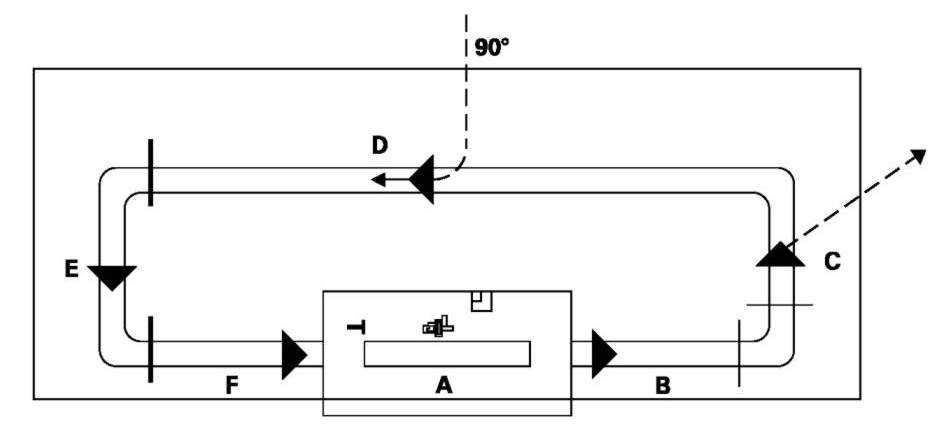
A. Runway
B. Take-off leg
C. Crosswind leg
D. Downwind leg
E. Base leg
F. Final leg
The aerodrome circuit area is established for each runway. The lateral dimensions are also dependent on the local circumstances. The standard aerodrome traffic circuit as depicted above is situated within the aerodrome circuit area. The vertical dimensions extend from aerodrome level up to 1000 FT / 300 M AAL.
The standard aerodrome traffic circuit height is 700 FT / 210 M AAL.
1. Climb to 700 FT / 210 M AAL. A climbing turn to crosswind leg is allowed, if necessary to stay within the aerodrome traffic circuit area.
2. Fly horizontally at 700 FT / 210 M AAL.
3. Maintain 700 FT / 210 M AAL at downwind leg.
4. Make a descending turn at base leg so as to start the final approach from at least 300 FT / 91 M AAL.
5. Make the final approach.
Note:
within the aerodrome traffic circuit it is not allowed to overtake other aircraft.
In case of an overshoot the pilot has to climb and join safely the aerodrome traffic circuit.
Note:
a shortened aerodrome traffic circuit is no longer prescribed, but may be flown if safety is guaranteed.
1. Before executing the joining of the aerodrome traffic circuit, pilots have to take notice of the signals displayed in the signal area or of the information given by radio. Overflying the circuit area for observing the signal area shall be done at a height of at least 1000 FT / 300 M AAL.
2. Descending or climbing to circuit height must be executed outside the lateral limits of the circuit area.
3. The joining of the standard aerodrome traffic circuit shall take place half-way downwind leg at an interception angle of 90°.
1. Leaving of the aerodrome traffic circuit shall take place at an angle of 45° half-way crosswind leg unless local circumstances force to establish an other route which will be promulgated separately.
2. Climbing or descending to cruising level must take place outside the lateral limits of the aerodrome circuit area.
When other aerodrome traffic is not hindered, the above mentioned rules do not apply:
- when other rules are determined, due to local circumstances.
- to banner-flights, specifically to this part of the flight regarding the hooking on, respectively disengaging of the towing banner.
- to crop-dusting flights with loaded crop-dusting aircraft, during take-off and leaving the circuit, and while sprinkling areas in the circuit area.
- to (simulated) forced landings.
The conditions for manned free balloon flights at aerodromes are laid down in the decree of designation of the aerodromes in question. For ascents from these aerodromes permission from the aerodrome operator is needed. For ascents from a military aerodrome permission from the aerodrome commander shall be obtained at least three weeks in advance.
No exemption is required for balloon ascents from areas other than aerodromes, providing that the ascents are carried out in accordance with the rules concerning the use of areas other than aerodromes. See Article 27 of the "Regeling veilig gebruik luchthavens en andere terreinen" (in Dutch only).
For aerodromes designated as balloon flight locations, see ENR 5.5.
Avoid the circuit areas of uncontrolled aerodromes during the balloon flight. If crossing the circuit area can not be avoided the balloonist should co-ordinate this with the airport manager by telephone.
For safety reasons you are strongly advised to keep two-sided radio contact with the airport manager when flying close to or crossing the circuit area of an uncontrolled aerodrome.
If an ascent or planned landing will take place within a CTR, initial permission needs to be requested by telephone at least 4 hours in advance from the appropriate air traffic service.
The following conditions apply:
Note:
taking into account the nature of balloon flights and the amount of traffic in the Schiphol CTR, permission for ballooning within the Schiphol CTR will most likely not be given.
The initial permission may come with further conditions and/or restrictions with respect to (amongst others):
- Flight altitude;
- Two-way radio communication;
- The presence of a transponder and/or radar reflectors;
- Possible other or supplementary agreements concerning the filing of the flight plan;
- Contact with the relevant air traffic service before the final permission (see paragraph 10.3.2)
To receive the final permission the captain should phone the following authorities within 15 minutes before the ascent:
Note:
it is recommended to request initial permission before beginning other pre-flight preparations.
The final permission may come with further conditions with respect to (amongst others):
- clearance limit;
- telephonic request of lift off clearance and/or report immediately following lift off;
- procedure to follow if no radio contact has been established before reaching a height of 500 FT AGL;
- reporting end of flight.
The flight plan needs to be filled in accordance with the rules laid down in section 4 of the Annex to commission implementing regulation (EU) No 923/2012. For further information on flight planning, see ENR 1.10.
For balloon flights the following applies:
- for ascents from designated aerodromes the flight plan shall be filed at the ARO concerned;
- for flights from a non-designated aerodrome the flight plan shall be filed at Amsterdam FSC or Mil FDNO at MILATCC Schiphol;
- arrival reports shall be submitted to the relevant authority within 30 minutes after the end of the flight.
- item 9 (aircraft type designator) of the flight plan shall read "BALL".
- it is not allowed to fill in item 18 (flight duration) of the flight plan "RMK/NO EET". An estimated time needs to be stated, taking into account the available fuel and general planning.
- enter the pilot's mobile telephone number in item 19 of the flight plan to enable two-way telephone contact with ATC.
It is not necessary to contact ATS by telephone, except for announcing or canceling planned balloon flights within CTRs. Balloon flights in airspace classes G and E can take place according to visual flight rules without prior notice to ATS.